Pilot your Project: Avoiding Anti-Patterns While Handling Incidents and Planning

summary
Claim: human error causes most failures and aviation fixes prove methods work. Evidence: FAA regulation and training cut accidents dramatically and a runway mistake kills—82 aboard, 72 dead. Cognitive limits are concrete: seven items in working memory, three levels of abstraction, ~4 bits per second processing. Hazardous attitudes—macho, anti-authority, resignation, invulnerability—drive bad choices. Practical tools: adopt the perceive process perform loop, favor small reversible changes (canary-style deployments) and explicit ownership.
AI-written summary · about
chapters (26)
- 0:00Intro
- 0:43Who am I
- 1:00Hobbies
- 1:50Everything is a problem
- 2:21Antipatterns
- 3:15Answering the wrong questions
- 3:44Stop jumping ahead
- 4:30Steal from the government
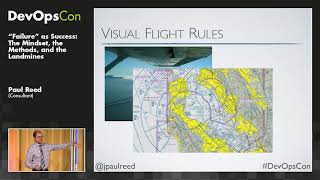
- 4:52Steal from the FAA
- 7:36Serious soulsearching
- 8:32Dramatic decrease in accidents
- 9:12People are the problem
- 9:46Humans have fundamental limits
- 10:24Memory Perception Limits
- 12:57Our Brain Plays Tricks
- 13:36Procedural Errors
- 15:19Decision Errors
- 16:31Diffusion of Responsibility
- 17:53How do you solve problems
- 19:22aeronautical decisionmaking
- 20:11bias towards action
- 21:54Three Ps
- 23:15Gut Check
- 24:20Hazardous Attitudes
- 25:59Theres Not a Silver Bullet
- 27:00Questions
related talks
 29mLearning from incidents: how things went right
 42mHow to not kill people
 40mBuilding Resilience: How to Learn More from Incidents
 09mSpeaking Planely for the Grounded Professional
 32mScaling a Responsible Agentic Workforce
 53mMayday Mark 2! More Software Lessons From Aviation Disasters.
 53mMayday! Software lessons from aviation disasters
 31m"Failure" as Success: The Mindset, the Methods, and the Landmines