Beyond MLOps
summary
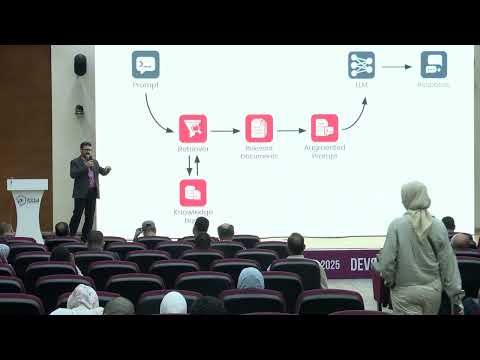
Giza Systems reports implementing RAG on multiple mega-projects (60–70% government customers) by combining retrieval-augmented generation with vector databases and a retriever+LLM pipeline; system reaches roughly 90–95% accuracy for supported queries but still shows fractional hallucinations. RAFT and BAFT style fine-tunes plus LoRA make models runnable on modest infra and even laptops. Outcome: automated incident triage that finds ransomware access, shortens MTT R, reduces engineer burnout, and scales knowledge transfer across teams.
AI-written summary · about
chapters (12)
- 0:00Introduction to company
- 2:59Why we built this solution
- 6:10The LLM analogy problem
- 8:24RAG technology overview
- 10:57Vector databases explained
- 13:10Retriever engine deep dive
- 17:15Fine-tuning limitations
- 18:38Raft and BART models
- 20:28Code generation risks
- 21:35Automated operations impact
- 23:24Reducing downtime benefits
- 24:07Data restrictions context
related talks
 31mAdvanced Enterprise RAG Systems
 29mBuilding the Bridge Between DevOps and MLOps in a GenAI world
 44mWhat Is a RAG System and How to Build One
 17mScaling Enterprise-Grade RAG: Lessons from Legal Frontier
 46mLeveraging AI and Automation in DevOps
 44mRAG for a Medical Company: Technical and Product Challenges AI & Data
 53mExperience with an end-to-end MLOps pipeline: Practical insights and 3D architectural perspectives
 33mBuilding Resilient (ML) Pipelines for MLOps