Complex Event Flows in Distributed Systems

summary
Argues that event-driven messaging (Kafka) helps local decoupling but breaks end-to-end visibility, so critical business flows get orchestrated as commands rather than pure events using lightweight workflow engines (BPMN, AWS Step Functions, Cadence, Conductor, Zeebe). Shows concrete patterns: stateful retry and compensating transactions (sagas) for payment/credit-card failures, embeds engines inside services or runs them as containers, and cites a production example handling about 25 million orders per quarter with this hybrid approach.
AI-written summary · about
chapters (23)
- 0:00Intro
- 1:24Bernds background
- 3:10Setting the scene
- 4:36EventDriven Architecture
- 6:45The Golden Hammer
- 13:15A Different Approach
- 15:59Orchestration
- 19:20Bad API
- 22:38State handling
- 24:10Workflow engines
- 26:03Workflow engine market
- 27:58Code walkthrough
- 30:30Distributed systems
- 33:48Payment example
- 37:46Compensation
- 43:09Best DevOps
- 44:36BPMN
- 45:26Orchestration Logic
- 47:01Running Workflow Engines
- 48:13Summary
- 48:33Reality Check
- 49:02Code
- 50:01Recap
related talks
 47mComplex event flows in distributed systems
 23mEvent-Driven Architecture: Unleashing responsiveness
 57mEvent Driven Collaboration
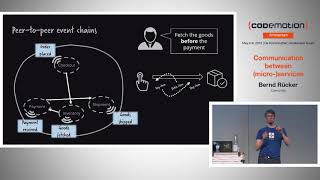 40mCommunication between (micro-)services
 52mSo You Want to Build An Event Driven System?
 54mHow Events Are Reshaping Modern Systems
 55mAn Introduction to Enterprise Design Events
 47mEvent-Driven Microservices = Microservices Done Right