AddressSanitizer/ThreadSanitizer for Linux Kernel
summary
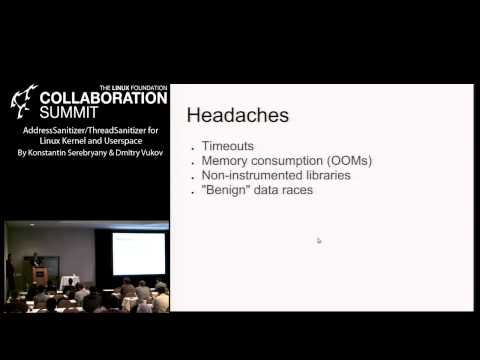
AddressSanitizer catches stack/heap/global buffer overflows and use‑after‑free via compiler instrumentation (LLVM/GCC) and a shadow memory layout, typically incurring ~2x slowdown and 2–3x memory overhead; Google reports 2000+ security bugs found in two years and ~1000+ in Chrome. ThreadSanitizer records per‑8‑byte shadow cells to detect races with low (2–4x) slowdown. A kernel proof‑of‑concept adds slab red zones and plans a shadow memory mapping in physical memory, but faces bootstrapping, interrupt, atomic‑operation and instrumented‑library challenges.
AI-written summary · about
chapters (5)
- 0:00Start
- 3:41Finding Stack Buffer Overflows
- 18:15Compiler Instrumentation
- 24:59Function Interceptors
- 33:58Ideal Address Space Layout
related talks
 01h 02mSanitize your C++ code
 40mAddressSanitizer, or How to Make C/C++ Programs More Reliable and Secure
 06mLightning Talk: You Should Use AddressSanitizer
 59mBeyond Sanitizers...
 01h 29mAddressSanitizer on Windows
 01h 00mSanitize for your Sanity: Sanitizers tools for Modern C++
 59mSanitizing the Linux Kernel — On KASAN and other Dynamic Bug-finding Tools
 31mEnable debug tools on Golang for arm platform (MSan & TSan)