Spaaaaaaaaace
summary
Claims concrete numbers like 29.6 megajoules per kilogram to reach orbital sideways speed and ~17,000 miles per hour for low Earth orbit, notes equatorial launch saves ~1,000 mph, and compares the Apollo guidance computer to an iPhone 5s with a specific multiplier. Describes built hardware and experiments: a prototype lunar miner and an on-orbit experiment, plus a Kerbal/HTTP-enabled part and a Ruby PID controller that actually hovers at 150 meters with minor lateral drift, code hosted on GitLab.
AI-written summary · about
chapters (20)
- 0:00Start
- 4:27Apollo Guidance Computer
- 6:47Pre-Bendyworks
- 9:33Orbital Requirements
- 12:29Kinetic (speed)
- 13:10Equatorial Surface Speed
- 14:31Conservation of Momentum
- 15:06Converging-Diverging Nozzle
- 16:23Kepler's First Law
- 16:55Eccentricity
- 17:31Orbital Points of Interest
- 17:54Kepler's Second Law
- 18:49Kepler's Third Law
- 19:14Kepler's Laws of Planetary Motion
- 19:32Trip to Mars
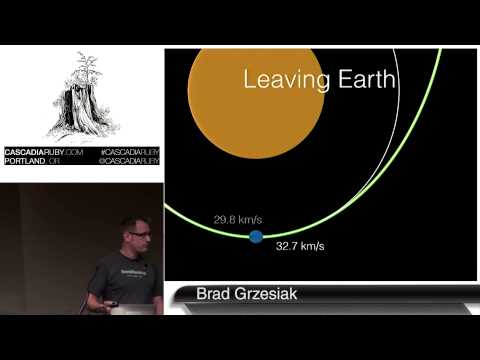
- 20:07Leaving Earth
- 20:38Arriving at Mars
- 21:59Landing
- 22:25Aerobraking
- 26:46Throttle Height