Architecting for DevOps and Continuous Delivery

summary
Claims that teams can go fast and stay safe by designing for small, testable changes and automating builds, tests and deployments, backed by state‑of‑the‑art tooling: Azure Pipelines, ARM templates for infra as code, SonarCloud scans, Kubernetes/Service Fabric clusters, Polly retries and circuit breakers, SpecFlow + Selenium for UI tests, and Entity Framework migrations. Demonstrates a working cookie‑based canary that routes 10% then 40% then 100% of traffic and asserts monitoring gates before full cutover.
AI-written summary · about
chapters (17)
- 0:00Introduction and welcome
- 1:46What is Continuous Delivery?
- 6:44Four foundations of Continuous Delivery
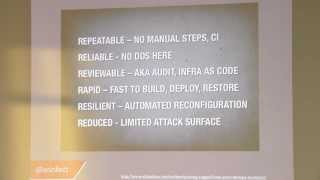
- 10:12Architecture principles for DevOps
- 12:44Decomposition and components
- 15:13Challenges of distributed systems
- 17:39Microservices architecture considerations
- 20:24Handling downstream failures
- 22:31Monoliths vs microservices
- 24:15Monolith first approach
- 25:37Migration patterns to microservices
- 26:40Designing deployment pipelines
- 31:58Canary deployments demo
- 34:49Feature flags and releases
- 37:15Testing pyramid explained
- 40:20Database changes in pipelines
- 42:24Summary and Q&A
related talks
 51mBetter software, faster: principles of Continuous Delivery and DevOps
 53mDevOps and Agility with Visual Studio, Azure and Scrum
 55mPatterns & Anti Patterns for Scaling & Enabling DevOps Adoption
 59mDevOps for the Discouraged
 23mCI/CD at Scale: Best practices with AWS DevOps Services
 06mLightning Talk: Safe to Fail Continuous Delivery Culture
 01h 01mA team's transition to Continuous Delivery
 26mThe Road to Full Automation: How We Implemented Continuous Delivery at Signal