High-Rate Fair-Density Parity-Check Codes
summary
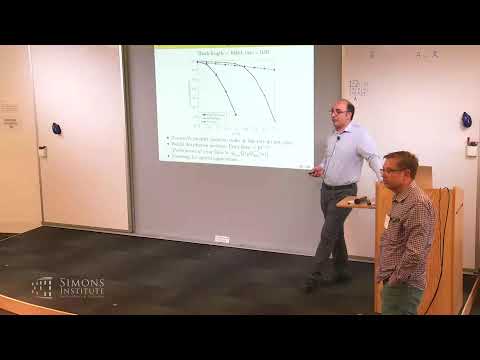
Introduces a deterministic construction: a base matrix with two-ones columns with about 2√n rows, then stack permuted copies to get high-rate codes whose low-weight codewords are provably scarce, enabling union-type ML bounds and a predicted error floor around 10^-16. Implements a low-complexity decoder, MP-PL weighted min-sum + progressive list, that beats 5G LDPC by ≈0.5 dB at n=1024, tracks the RCU bound on BEC, and yields linear-time decoding with much lower latency and complexity than SCL polar.
AI-written summary · about
chapters (8)
- 0:00High-rate fair-density codes
- 1:54High-rate code requirements
- 5:47Fundamental limits analysis
- 13:48Motivation for sparse BP-decodable codes
- 19:10Constructing fair-density codes
- 26:19Simulation results comparison
- 32:42Progressive list decoding
- 37:49Conclusion and future work
related talks
 01h 09mWhen Cryptography Meets Modern Channel Coding
 49mHigher Order MDS Codes
 46mCodes with the multiplication property
 44mCoding Theory in Almost Linear Time and Sublinear Space
 04mError-Correcting Codes: Theory and Practice
 39mGilbert and Varshamov meet Johnson: List Decoding Nearly-Optimal Binary Codes
 52mFast list-decoding of univariate multiplicity and folded Reed-Solomon codes
 46mList-decoding random codes ensembles