Coded matrix computation: numerical stability, partial stragglers and sparse input matrices
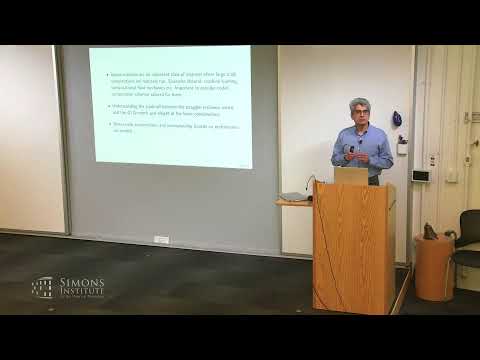
summary
Introduces a real-valued coding scheme that embeds rotation and circulant permutation matrices so Vandermonde-like decoding matrices have unit-circle conditioning without complex arithmetic, achieving the known optimal recovery threshold while keeping worker cost low. Proposes a block-cyclic, class-based assignment that subpacketizes to exploit partial stragglers and preserves sparsity (only a small fraction of A blocks are coded), proves worst-case Q bounds and shows numerical experiments where condition numbers drop from ~10^14 to ~10^2 and decoding succeeds.
AI-written summary · about
chapters (6)
- 0:00Coded matrix computation intro
- 5:08Vandermonde instability
- 15:01Stable coded computation
- 27:13Partial stragglers handling
- 34:24Sparse matrices trade-offs
- 42:10Summary
related talks
 25mSimple, Efficient and Neural Algorithms for Sparse Coding
 28mCommunication Avoiding Algorithms for Linear Algebra and Beyond
 44mStochastic Integration via Error-Correcting Codes
 28mRandomized Constrained Matrix Decompositions
 37mSparse Superposition Codes for the AWGN Channel, Message Passing, Replica and Spatial Coupling
 26mAdaptive Coding over Countable Alphabets
 45mTeaching an old code a new trick
 31mMulti-version Coding and Shared Memory Emulation