State of Open Source AI Coding Models

summary
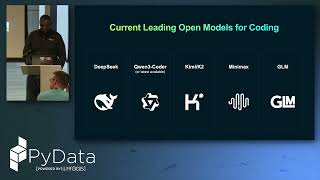
Hugging Face hosts over 2 million models and 500k datasets and shows that coding models now close the gap with closed systems: open weights vs fully open matters for reproducibility, but models like Qwen3‑Coder, GLM‑4.5/4.6 and Moonshot’s Kim K2 (a one‑trillion‑parameter model) reach frontier accuracy while reducing latency and cost. Real deployments fine‑tune these bases (StarCoder → StarCoder2; Quen → Zetta) using RL techniques such as RLVR reinforcement learning from verifiable rewards, and companies report sub‑500 ms latency and ~94% diff‑edit success.
AI-written summary · about
chapters (17)
- 0:00Introduction by host
- 1:15About the speaker
- 3:02Hugging Face ecosystem
- 5:06Open weights vs open source
- 7:10Pros and cons of models
- 8:16Performance gap closing
- 9:41Fine-tuning for coding
- 11:47History of coding models
- 13:11StarCoder and FIM objective
- 14:55StarCoder 2 release
- 15:37Qwen 2.5 Coder
- 16:41DeepSeek R1 impact
- 17:45Qwen 3 and GLM models
- 20:10Cost and performance trends
- 21:36Kim K2 breakthrough
- 22:40Getting started resources
- 23:46Q&A session
related talks
 32mThe Rise of AI agents and open sources Ai models
 49mOpen Models: The Secret Weapon for Next-Generation Software
 25mOpen AI (Two Words): The Only Path Forward for AI
 40mKeynote: Open-source Multimodal AI in the Wild
 10mThe Future for AI-First Enterprises is “Open” - How to Succeed and Not...
 17mKeynote: An OPEN Path to Super Intelligence
 35mUsing coding agents with open models
 44mKeynote: Tracking the Pulse of Generative AI