Layer Codes
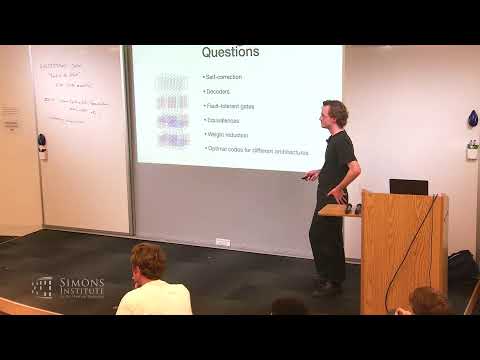
summary
Claim is that one can saturate 3D locality bounds to get essentially optimal local quantum LDPC codes by concatenating good LDPC codes with stacked surface code layers and using lattice surgery plus the folding trick to turn nonlocal high‑weight checks into local checks of weight ≤6. Construction embeds on an L×L×L grid so n ~ L^3, k ~ O(L), and d ~ O(L^2)/w where w is input check weight, and it provably preserves an energy barrier scaling ∝ L up to constant factors, so the construction works to meet the BPT-type limits.
AI-written summary · about
chapters (11)
- 0:003D quantum codes intro
- 1:08Motivation for layer codes
- 2:55LDPC and surface codes background
- 9:20BPT bounds in two and three dimensions
- 15:22Concatenating surface and LDPC codes
- 21:05Defects and lattice surgery in 3D
- 27:06Stabilizer construction
- 31:02Code parameters and scaling
- 37:03Energy barrier and thermal robustness
- 40:19Open questions and future work
- 42:46Q&A
related talks
 39mExpansion of Higher-Dimensional Cubical Complexes With Application To Good ...
 32mTowards local testability for quantum coding
 01h 03mQuantum LDPC Codes with Transversal CCZ Gates
 34mExplicit Abelian Lifts and Quantum LDPC Codes
 35mHalving the cost of surface codes by running error correction at the logical level
 44mNLTS Hamiltonians (and Strongly-Explicit SoS Lower Bounds) from Low-Rate Quantum LDPC Codes
 49mCircuit lower bounds for low-energy states of quantum code Hamiltonians
 45mOn the NLTS Conjecture