Concurrency, Parallelism and Coroutines
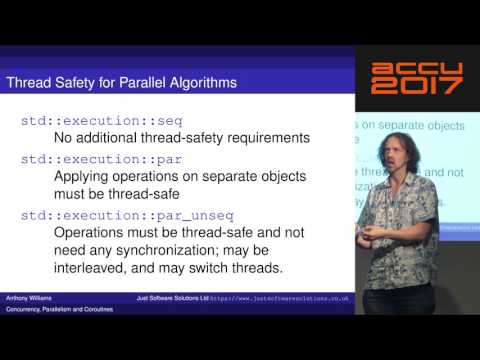
summary
C++17 adds new overloads with an execution policy so algorithms can run as seq, par, par_unseq; coroutines (co_await / co_yield / co_return) suspend and resume with preserved locals and integrate with futures so continuations run without blocking. The Concurrency TS supplies continuation-based futures, when_any/when_all, latches, barriers and atomic smart pointers. The Executors proposal defines handles and operations like execute/post/defer (plus sync_execute and bulk submission) to control where and how tasks run and to enable coroutine-aware parallel algorithms.
AI-written summary · about
chapters (6)
- 0:00Introduction
- 1:25Parallel algorithms
- 16:51Coroutines TS
- 31:12Concurrency TS
- 55:44Integrating components
- 58:20Executors and wrap-up
related talks
 01h 05m“Concurrency, Parallelism and Coroutines”
 01h 04mConcurrency in C++20 and Beyond
 48mStructured Concurrency: Writing Safer Concurrent Code with Coroutines...
 01h 24mConcurrency in C++20 and Beyond
 48m“Coroutines: what can't they do?”
 58m“Introduction to C++ Coroutines"
 01h 30mC++ Coroutines and Structured Concurrency in Practice
 01h 16mConcurrency Approaches: Past, Present, and Future