Crypto-Economic Coprocessors & Their Applications

summary
Claims that a blockchain can act as a cryptoeconomic co-processor that runs native on-node computation and attests results via consensus + state proofs (headers + Merkle roots). ZK proving suffers asymptotic slowdown (example: 10 minutes native → 1–10 hours in a SNARK and n instances require n−1 extra proving steps), so blockchains offer native speed and cheap blockspace but require high economic security (not $10 but billions). Use cases: Polkadot/HyperBridge-style message aggregation, TWAP and reputation state processors, DA and ZK-aggregation hubs.
AI-written summary · about
chapters (11)
- 0:00Cryptoeconomic coprocessors intro
- 2:11Why blockchains need coprocessors
- 3:56ZK coprocessor limitations
- 8:11Blockchains as verifiable computers
- 11:20How cryptoeconomic proofs work
- 13:08Coprocessor requirements
- 14:10Blockchains as services
- 14:51Interoperability coprocessor apps
- 15:54State/data coprocessor apps
- 16:57ZK aggregation & TE ideas
- 17:42Future possibilities
related talks
 31mZK Stack and the Rise of the Rollup-State
 29mZEXE: Enabling Decentralized Private Computation
 01h 23mProgram Presentations
 54mZexe: Enabling Decentralized Private Computation
 22mHow Zero Knowledge Proofs Change the Narrative Around Privacy
 53mProofs Without Evidence: Assurance on the Blockchain and Other Applications
 17mZK for the Enterprise - Quod Erit Demonstrandum (What Will Need to be Proven)
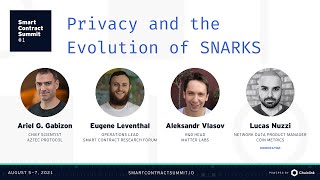 39mPrivacy and Evolution of SNARKs