Native CPU Performance in the Brow

summary
Native Client brings native x86 (32/64) code into browsers via an NPAPI plugin and a sandboxed container that forbids filesystem or raw syscalls and uses static validation; benchmarks show C beating JS (V8) from about 2x on large HTML table work to ~6x on numerical kernels; a video decoder and image-editor demos run at near-native speed; security review, open source paper, and a contest with 400 teams 600 individuals yield only 22 bugs, mostly not in the inner sandbox.
AI-written summary · about
chapters (4)
- 0:00Start
- 1:42Why Native Code? Close the gap between desktop and web apps - Performance - Choice of programming language - Leverage legacy code
- 3:07What we mean by "Performance" Key performance features include . POSIX-like thread support • Straightforward access to vector instructions • Hand-coded assembler
- 6:33What does it mean for the Web? Desktop CPU performance will enable Web apps with
related talks
 20mNot So Fast: Analyzing the Performance of WebAssembly vs. Native Code
 30mNative Speed on the Web: JavaScript and asm.js
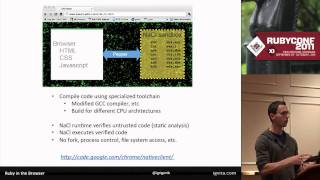 58mRuby in the browser with NativeClient (NaCl)
 01h 14mC++ on the Web: Ponies for developers without pwn’ing users
 30mBeyond the Web of Today
 39mHow much performance can you get out of Javascript?
 19mLessons learnt pushing browsers to the limit
 32mC++ Everywhere with WebAssembly