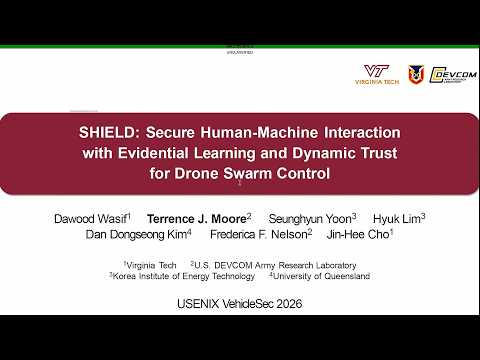
SHIELD: Secure Human-Machine Interaction with Evidential Learning and Dynamic...
summary
SHIELD is a decentralized swarm-control framework that uses evidential vacuity (Dirichlet-based perception) to drive a dynamic trust graph and an embedded intrusion-response system, plus an event-triggered binary confirmation interface for humans. Evaluated in the quad swarm simulator across six attack classes and 8–32 UAVs, it reports up to 60% relative mission-success improvement, >80% detection of compromised agents with <15% false positives, and a 53% reduction in human interventions; ablations show complementary module benefits.
AI-written summary · about
chapters (12)
- 0:00Introduction
- 1:13Human-UAV swarm challenges
- 2:39Evidential vacuity in SHIELD
- 3:41System model and attack classes
- 4:49Decentralized control loop
- 6:36Adaptive trust and resilience
- 7:40Consensus-based safety arbitration
- 8:22Simulation and baselines
- 9:48Detection performance and workload
- 10:30Ablation studies and scalability
- 11:14Limitations and future work
- 12:40Conclusion
related talks
 40mA Primer: Getting Started with MITRE Shield
 26mA Primer: Getting Started with MITRE Shield
 26mSHIELD: Protecting CF, Services and Applications Through Backups and Restores
 44mSwarmfare - When the shit hits a thousand fans
 01h 19mCrashing Drones and Hijacked Cameras: CyberTrust Meets CyberPhysical
 39mShield your Cluster: Security & Elasticsearch
 42mHuman in the loop is not enough
 12mMulti-Layer Defense for Scalable Threat Mitigation