Probabilistic Programming for Augmented Intelligence

summary
Probabilistic programming systems build two working tools: Picture, a Julia-embedded vision pipeline that combines a differentiable renderer, a convolutional-net comparator, gradient search and elliptical slice sampling plus learned Helmholtz proposals to infer 3D face models in tens of seconds; and BayesDB, a BQL front end using a CrossCat ensemble (64 models run for eight minutes) to analyze messy datasets (example: 250 patients × 400 blood variables from a €6M trial) and surface plausible predictors.
AI-written summary · about
chapters (15)
- 0:00Start
- 1:59Empirical inference at the Bill & Melinda Gates Foundation
- 5:17The MIT Probabilistic Computing Project
- 8:18Inference: Build a face shape and texture until it matches
- 9:00Inference in one page of Picture code
- 10:17Stochastic Scene Generator
- 13:06Probabilistic programming for machine-assisted visual art
- 20:12Challenges
- 22:06BayesDB: Detecting Biomarkers for Diabetes
- 25:10A dialog with a Virtual Data Analyst?
- 26:50From empirical data to credible knowledge in 30 minutes
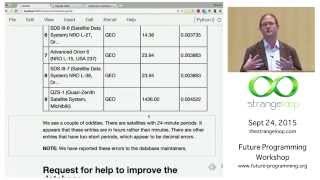
- 32:11BayesDB for understanding satellites
- 34:30Integrating Kepler's laws and a way to learn exceptions
- 37:51Natively probabilistic computation?
- 39:09Augmented Intelligence
related talks
 01h 03mAn Overview of Probabilistic Programming
 43mThe Power of Probabilistic Programming
 38mProbabilistic programming and meta-programming in Clojure
 01h 07mProbabilistic Programming and Readable Models
 36mProbabilistic Programs Which Make (Common) Sense
 31mProbabilistic Programming: The What, Why and How
 47mThe State of the Art for Probabilistic Programming
 42mBayesDB: Query the Probable Implications of Data