Differential Privacy

summary
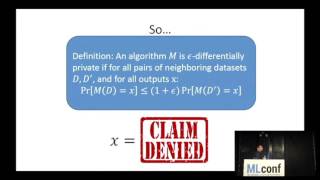
Survey of real attacks shows reidentification from anonymized records (Massachusetts medical release, Netflix Prize, GWAS/Homer). Formal guarantee treats the release algorithm as randomized and demands epsilon-differential privacy (with optional epsilon-delta slack): outputs from databases differing by one person are nearly indistinguishable. Simple mechanism adds Laplace noise to counts (Laplace mechanism), and privacy degrades under repeated use according to a composition theorem; typical epsilons around 0.1–2 give usable accuracy on large datasets but hurt small clinical cohorts.
AI-written summary · about
chapters (4)
- 0:00Start
- 13:08Resolving Individuals Contributing Trace Amounts of DNA to Highly Complex Mixtures Using High-Density SNP Genotyping Microarrays
- 30:31INTERPRETATION OF DIFFERENTIAL PRIVACY
- 31:17LAPLACE MECHANISM
related talks
 01h 00mDifferential Privacy: Fundamentals to Forefront I
 30mAccuracy First: Selecting a Differential Privacy Level for Accuracy-Constrained...
 20mShare data without revealing personal information
 01h 03mStatistical Inference and Privacy, Part II
 47mDifferential Privacy from a Statistical Perspective–Obtaining Valid Inferences...
 26mAaron Roth, Associate Professor, University of Pennsylvania, NYC 2017
 01h 43mPerspective
 27mYou've got trust issues, we've got solutions: Differential Privacy