Distribution Testing: Hypothesis Testing from Very Little (or Very Private) Data

summary
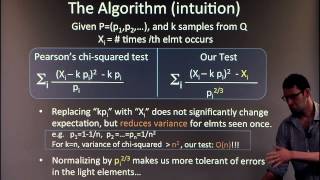
Overview of concrete results: distribution testing under total-variation needs Θ(√k/ε²) samples for uniformity, and common reductions let many identity tests reduce to uniformity. Key tools are Poissonization to make counts independent, the collision-based tester and the complementary unique-elements / chi-squared statistics, plus a surprising workable empirical estimator for identity. For private data the talk maps central/local/shuffle models to tight sample bounds and uses shuffle amplification to turn local protocols into shuffle-private ones.
AI-written summary · about
chapters (11)
- 0:00Introduction and preliminaries
- 3:43Defining property testing
- 5:44Properties and examples
- 15:05Testing vs. learning
- 21:03Hardness of uniformity testing
- 25:15Methodologies and tricks
- 32:51Uniformity testing algorithms
- 40:20Advanced testing techniques
- 57:04Differential privacy overview
- 1:03:49Private distribution testing
- 1:14:21Open problems and conclusion
related talks
 45mTesting and Learning Distributions Under Local Information Constraints
 30mStatistical Property Testing and Estimation Beyond the i.i.d. Setting
 23mTowards Practical Distribution Testing
 29mTesting Probability Distributions using Conditional Samples
 21mTesting Distribution Families
 44mSomething for Almost Nothing: Advances in Sub-Linear Time Algorithms
 33mLearning and Testing Structured Distributions
 48mA New Paradigm for Learning with Distribution Shift