Introducing CallTracing(tm), based on RabbitMQ, Spring and Zipkin

summary
ETrade’s CallTracing uses RabbitMQ (AMQP), Spring proxies/interceptors and Zipkin (collector, query service and web UI backed by Cassandra) to correlate a single user request across heterogeneous services. It generates UID-based trace IDs after seeing collisions in ~15 million traces, records span ID / trace ID model with parent ID* to reconstruct nested RPCs, and ships traces out of band to avoid payload bloat. It visualizes per-span timings and service dependency graphs but breaks on routers or non‑participating nodes unless extra annotations are added.
AI-written summary · about
chapters (9)
- 0:00Introduction and motivation
- 12:00Microservices and tracing challenges
- 23:07Core tracing concepts and Zipkin
- 33:22Span and trace ID deep dive
- 46:30Demo of basic tracing
- 54:35Zipkin UX and trace analysis
- 1:06:31Instrumentation and API design
- 1:13:27Production deployment and lessons
- 1:23:17Q&A and wrap-up
related talks
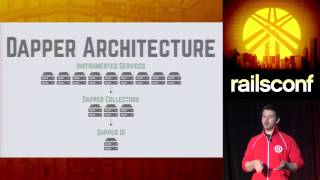 29mDistributed Request Tracing
 01h 11mDistributed Tracing : Latency Analysis for Your Microservices
 47mI'm Tracing You!
 23mIntroduction to OpenTracing
 49mDistributed Tracing: How the Pros Debug Concurrent and Distributed Systems
 57mDistributed Tracing: How the Pros Debug Concurrent and Distributed Systems
 42mDistributed Tracing Opening the Door to Visualisation and Correlation
 50mI'm Tracing you!