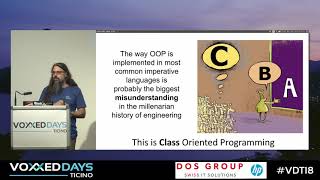
From OOP to FP

summary
Asserts there is no strict boundary between OOP and FP and that languages borrow features, then shows practical migration advice: use a function that returns a function (closures) to inject repositories, clocks or RNGs, replace in-place mutation by returning new objects (Ship of Theseus analogy), and keep all side effects outside an establish a boundary so inner code is purely functional. Claims this makes testing simpler (no heavy mocking, just provide functions), accepts performance and complexity tradeoffs, and illustrates with Java/Spring, Haskell, Docker and Mockito examples.
AI-written summary · about
chapters (4)
- 0:00Start
- 3:43Object-Oriented Programming
- 4:38Formalization of a Protocol
- 16:18What Does Functional Programming Mean