SEALS: A framework for building Self-Adaptive Virtual Machines
summary
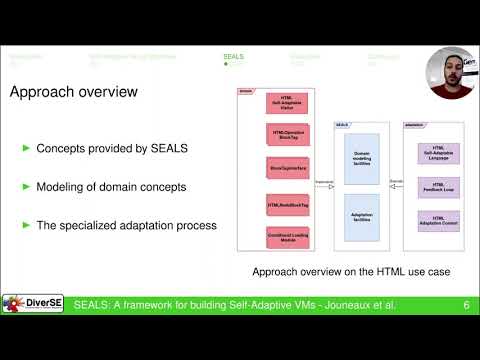
SEALS is a Java framework that reifies a MAPE-K loop into DSL virtual machines, supplying concrete concepts—Node, Operation, and a correctness envelope—and generating a generated adaptive visitor that applies adaptations at runtime. Three VMs are built (MiniJava, RobLANG, HTML); correctness envelopes force default semantics and bound allowed changes, preventing unsafe adaptations. Code size generally shrinks but Operations-as-classes inflate LOC for large languages; runtime overhead is small and performance is mixed but favorable for HTML and RobLANG versus manual implementations.
AI-written summary · about
chapters (14)
- 0:00Intro
- 0:22Context
- 1:13Contribution overview
- 1:48What are Self-Adaptable Virtual Machines
- 2:29Motivating Examples
- 3:37Approach overview
- 4:17Modeling of domain concepts
- 5:56Specialize the adaptation process
- 6:53Java Implementation
- 7:18Correctness envelope implementation
- 8:32Abstraction
- 10:15Performances and code size
- 10:57Conclusion The SEALS Framework
- 11:22Perspectives
related talks
 28mAdaptive Structural Operational Semantics
 26mArchSem: Reusable Rigorous Semantics of Relaxed Architectures
 37mAssembling
 45mMaking Java more dynamic
 17mTEAL: a Total Expressive Assembly Language
 42mEternal Sunshine of the Spotless Macro
 29mIntegrating Language Engineering into the Software Development Process
 01h 01mChallenges in the Design and Implementation of Teaching Languages for EDSLs