A Vision of Miking: Interactive Programmatic Modeling, Language Composition, and Compilation

summary
Miking presents a concrete framework: a functional core that auto-generates interactive programmatic modeling environments, composes reusable language fragments with a plan for sound language composition, and uses partial evaluation plus learned heuristics to build self-learning compilers that target LLVM for CPU and CUDA for GPU. Examples include compiling high-level mechanical models into DAEs with numerical solvers and probabilistic programs using delayed sampling and SMC; current prototype is untyped, aims for a polymorphic type system and mechanized semantics while focusing on runtime efficiency.
AI-written summary · about
chapters (15)
- 0:00Introduction
- 0:26Research Areas
- 0:41Interactive programmatic modeling
- 1:08Myking
- 2:49Framework
- 4:17CyberPhysical Systems
- 5:03Boolean Etiquette
- 6:22Physical Modeling
- 9:02Public Programming
- 12:40Compiler Construction Tools
- 13:02Fragments
- 14:09Compilers
- 15:09Related works
- 16:16Conclusion
- 21:01Part III
related talks
 54mProgramming Language Design and Implementation for the Machine Learning Era: A Personal(…)
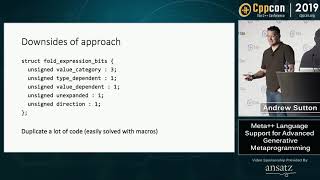 59mMeta++: Language Support for Advanced Generative Programming
 27mReclaiming the Unexplored in Hybrid Visual Programming
 48mCross-Domain Compilation: Exploiting Synergies Across the CS Community
 42mEternal Sunshine of the Spotless Macro
 54mProgramming Language Design and Implementation for the Machine Learning Era: A Personal(…)
 01h 31m"Thoughts on language evolution"
 41mThe Dialectics of Type-Level Programming