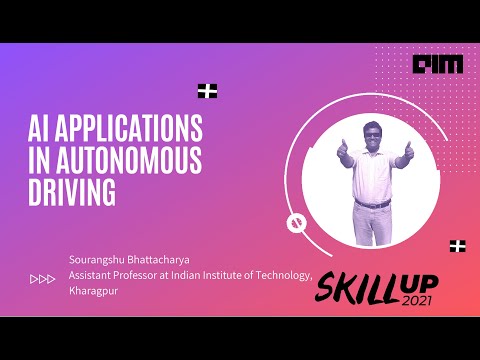
AI applications in autonomous driving
summary
Uses the open-source Carla simulator to generate camera, depth and semantic labels and trains an affordance-based driving model; proposes a multi-criteria online subset selection (TM-COS) that picks frames on-device to reduce storage and transfer. Experiments report a ~3% drop in mean IoU at 25:1 compression (100:4 selection) and ~2% drop at 100:15, while episode-completion on 10 CARLA routes remains nearly intact, with the system slowing and selecting more frames at turns.
AI-written summary · about
chapters (18)
- 0:00Start
- 6:09Scalable Autonomous Driving
- 7:26Outline
- 13:03Route Planning
- 14:17Other Simulators
- 14:47Demo Video using CARLA
- 19:23Models for Semantic Segmentation
- 20:27Autonomous Driving Model
- 22:21Old Paradigms Modular Pipelines
- 27:59Collection of Ground Truth Affordances
- 28:33Autonomous Driving is Data Intensive
- 30:12Preliminary results on CAL
- 31:55System Architecture
- 33:09Multi-criteria OSS Formulation
- 34:53Results on Semantic Segmentation
- 36:42Episode Completion
- 39:12Right turn video
- 40:00Left turn video
related talks
 31mDeep learning for self-driving vehicle technology
 17mBuilding Training Data for Autonomous Driving
 08mHuman–AI Collab for Reliable Automotive Control Systems
 26mAI for Autonomous mobile robots
 19mAI Trends in Intelligent Transport Systems
 24mAI in maritime - Autonomous ships
 17mRECL: Responsive Resource-Efficient Continuous Learning for Video Analytics
 41mKEYNOTE: Image processing, AI, and autonomous systems