Relative Entropy Relaxations for Signomial Optimization
summary
Introduces a hierarchy of convex relaxations for signomial optimization that uses relative entropy to certify nonnegativity via AM–GM weights, defines SAGE functions (sums of AM–GM exponentials) and shows the hierarchy is complete under mild exponent geometry, invariant under linear transforms and robust to small exponent perturbations; solves many non‑GP cases and is tight on about 60% of 80 random instances, implemented as convex programs solvable by interior‑point methods.
AI-written summary · about
chapters (26)
- 0:00Intro
- 3:13An application
- 5:03Another view
- 5:52Our approach
- 6:16Outline
- 6:55Basic idea
- 8:37Relative entropy and AM/GM
- 10:55Unconstrained SPS
- 15:39SAGE example
- 18:16SAGE decomposition
- 22:08More examples
- 24:48Completeness of hierarchy
- 26:20Dual viewpoint
- 30:17A basic relaxation
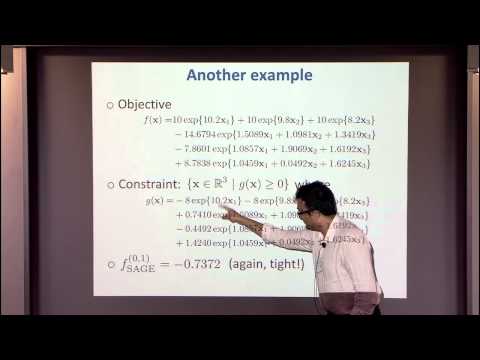
- 31:17Another example
- 32:10An example
- 34:12A hierarchy of relaxations
- 35:34Main proof idea
- 37:05Properties of these relaxations
- 38:28Robustness of SAGE relaxation
- 39:55Why are these true?
- 40:56Contrast with polynomial optimization
- 44:41Family of improved bounds
- 48:37An observation
- 51:34What underlies this?
- 52:14Summary