Continous integration of ML products and UX design

summary
Argues that product design must embed ML lifecycle work not just dashboards, giving concrete examples: a telemetry summarizer for core data aggregation and a user-facing recommendation engine (with reinforcement learning) that changes KPIs like time on app. Calls out tool history (Theano, Caffe, Keras) and today's AutoML pipelines, demands continuous testing and monitoring of model versions, and lists measurable risks — implicit vs explicit feedback, presentation and automation bias, capacity vs generalization — with design choices that alter data quality and model performance.
AI-written summary · about
chapters (22)
- 0:00Intro
- 0:55Datacentric companies
- 1:30Datacentric product design
- 2:33What is ML
- 3:12Learning from experience
- 4:00User experience
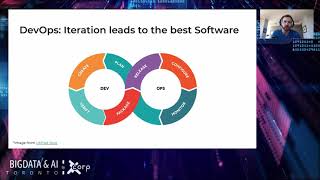
- 5:34Software life cycle
- 7:00ML life cycle
- 8:23ML frameworks
- 8:58ML as a service
- 9:24Automation
- 10:20ML Model
- 10:58Idea
- 12:16Performance
- 13:21Error
- 14:44Feedback
- 16:22Explicit Feedback
- 17:00Biases
- 18:44Presentation Bias
- 20:23Generalizability
- 21:46Capacity
- 25:33Conclusion
related talks
 26mCompleting the machine learning loop
 33mAI with a DevOps mindset - experimentation, sharing ..
 41mCan Data & ML really learn from software engineering?
 27mExplainable Artificial Intelligence and Continuous Delivery: Towards the intelligent organization
 30mBuilding Teams and Culture that Support ML Innovation
 43mUX and the Changing Relationship Between Mind and Machine
 17mContinuous deployment for ML: The new software development lifecycle
 54mArtificial Intelligence seen from the software development lifecycle perspective