Proving UNSAT in Zero Knowledge

summary
A practical zero‑knowledge protocol proves propositional UNSAT by encoding clauses as polynomials and checking resolution steps as algebraic relations over a finite field; the implementation uses polynomial encoding of clauses plus authenticated evaluations at random points to verify resolvents without revealing formula or proof and demonstrates real driver‑verification instances in about 300 seconds. The prototype handles proofs up to about width 1,000 and length 600K before running out of memory; read‑only array checks and MPC variants are used for other components.
AI-written summary · about
chapters (10)
- 0:00Motivation and context
- 2:56Defining the problem
- 5:42Resolution proof basics
- 10:25Zero knowledge foundations
- 18:59Privacy-preserving protocol
- 22:35Polynomial encoding approach
- 28:39Fetching clauses in ZK
- 29:50Performance and benchmarking
- 35:01Future directions
- 40:18Q&A and conclusion
related talks
 33mAn Introduction to Zero Knowledge Proofs
 01h 13mA Zero-Knowledge PCP Theorem
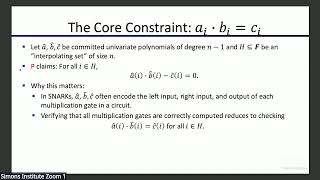 01h 09mProofs - Practice 1
 49mLattice-Based Zero Knowledge and Applications
 23mZKBoo: Faster Zero-Knowledge for Boolean Circuits
 01h 06mLattice-based Zero-knowledge Proofs
 38mNew Techniques for Zero-Knowledge: Leveraging Inefficient Provers to Reduce Assumptions, ...
 28mZero Knowledge Proofs and Their Future Applications