Under a Microscope: Exploring Fast and Safe Rust for Biology

summary
Starts from RNA‑seq basics and gives concrete engineering outcomes: a ~3,000‑line CLI stack balloons to >10,000 lines then shrinks sixfold after Rust rewrites; parsing uses crates like nom logos and pest; interop via cxx and FFI ties to C++ Python Perl; parallelism with rayon matters because datasets hit 10^16–10^17 bases (~100 petabytes); real runs with 30M reads need 64–128 GB RAM, some tools finish in 10–30 minutes while others take days or run out of memory.
AI-written summary · about
chapters (13)
- 0:00Introduction
- 0:38Overview
- 1:00What is RNA sequencing
- 4:52What is RNA analysis
- 7:11RNASeq Tools
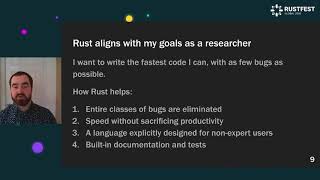
- 9:13Introduction to Rust
- 9:52Building ergonomic abstractions
- 16:53Biological file formats
- 19:14Basic processing
- 20:08Personal test
- 21:11Parallelization and efficiency
- 23:24Languages and tools
- 27:48Next steps