The Unbreakable Code Whose Breaking Won WWII
summary
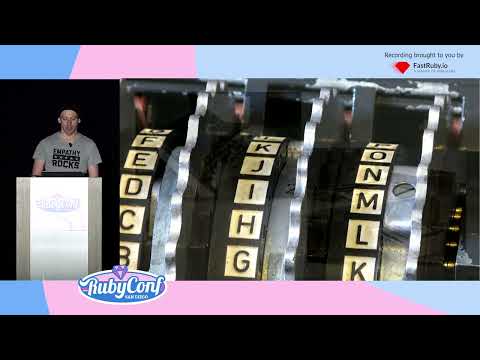
A working Ruby emulator reconstructs Enigma with concrete classes for keyboard, lampboard, rotor and spindle and uses MiniTest-driven TDD to prove behavior. Tests run green as the code enciphers phrases, implements rotor stepping and rollover, supports configurable sets (three or four rotors), and keeps plugboard/reflector work separate. Claims include Enigma’s 17,576 rotor positions and ~150 million million million settings and the historical estimate that Bletchley’s work shortens the war by 2–4 years.
AI-written summary · about
chapters (16)
- 0:00Enigma machine and Bletchley Park
- 2:36Enigma encryption
- 10:48Enigma and OOP model
- 11:53OOP design principles
- 13:20Enigma simulation with TDD
- 15:45Refactoring with the Single Responsibility Principle
- 17:51Extracting Keyboard class
- 20:40Lamp Board and design
- 21:43Testing Enigma settings
- 24:53Extracting Rotor class
- 25:56Rotor stepping for encryption
- 28:48Refactoring rotor advancement
- 31:00Introducing Spindle class
- 33:13Abstracting ciphering mechanism
- 34:42OOP principles and Enigma’s legacy
- 35:46Closing remarks
related talks
 01h 27mBuilding the Unbreakable Code Whose Breaking Won WWII
 39mEsoteric, Obfuscated, Artistic Programming in Ruby
 52mWho Wants to be a Ruby Engineer?
 41mCoding like it’s 1977: Ruby on the Apple ][
 20mLet's Play Ruby Golf
 28mLet's write an esoteric language in Ruby!
 36mUnfactoring From Patterns
 43mWho Wants to be a Ruby Engineer?