Predicting Intersection Signal Timing

summary
Claim: intersections are urban bottlenecks whose throughput and delay are set by cycle length, phase durations and offsets. Uses detector logs and historical phase durations, models actuated logic as min green / extension / gap-out, predicts remaining green by the conditional expectation of residual duration from past cycles, and computes eco‑driving speed profiles by dynamic programming. Experiments and simulations report an eco‑driving fuel reduction of up to ~20%, while dynamic offsets remain hard to solve in networks.
AI-written summary · about
chapters (11)
- 0:00Intro
- 1:40Intersection bottlenecks
- 3:35Signal control parameters
- 5:25Queueing theory
- 9:15Duration
- 11:50Offset
- 17:10The Basics
- 22:30Example
- 33:40Fuel Consumption
- 34:55Dynamic Programming
- 40:30Trucks and Buses
related talks
 29mDecentralized Signal Control for Urban Road Networks
 17mReasoning about Network Traffic Load Property at Production Scale
 18mMeasuring Congestion in High Performance Datacenter Interconnects
 21mSemi-Oblivious Traffic Engineering: The Road Not Taken
 17mTowards provably performant congestion control
 13mWIP: Learning Adversarial Attacks on Adaptive Traffic Signal Control Systems...
 28mRock around the clock (synchronization
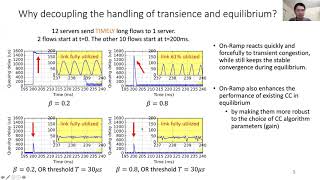 12mBreaking the Transience-Equilibrium Nexus: A New Approach to Datacenter Packet Transport