Mind-Reading with Adaptive and Intelligent User Interfaces

summary
Claim: adaptive UIs learn and personalize in real time by turning executable models into live behavior. Concrete tools: finite state machines and statecharts (Xate/XState style), weighted graphs, decision trees, and reinforcement learning, plus analytics plumbing (Google Analytics, Segment, Mixpanel) and the React useMachine hook. Examples and results: a feedback-form demo that stops nagging users, analytics showing 90% vs 10% transition weights and equal join/share splits in Live Share, and production precedent in SCXML for the Curiosity rover.
AI-written summary · about
chapters (42)
- 0:00Introduction
- 0:37Sponsors
- 0:47User Behaviour
- 2:22Everyone is Different
- 2:40AP Testing Is Ineffective
- 3:40Linear Selling
- 4:03Samson JS
- 5:02Adaptive User Interfaces
- 5:33Flipping
- 5:52Deleting
- 6:49Gmail
- 7:23User Interfaces
- 7:59Model Driven Development
- 8:41Abstract Models
- 9:48Transitions
- 11:31Actions
- 11:57Transition States
- 12:17Hierarchy
- 12:34Orthogonal
- 12:54Grouping States
- 13:33Example
- 14:12Finite State Machine
- 15:49UseProducer
- 17:01Object Mapping
- 18:07ExDates
- 19:27Gameplan
- 19:57Adaptation
- 20:15Weighted graphs
- 21:01Why is this important
- 21:37Visual Studio Live Share
- 23:21Demo
- 27:45Decision Trees
- 29:50Higher Order Markov Models
- 30:36Reinforcement Learning
- 31:43User Experience
- 32:46Modeling Considerations
- 33:27SCXML
- 35:17Advantages of SCXML
- 36:40Cons of SCXML
- 37:17Complexity tradeoff
- 37:54Resources
- 38:22Tools
related talks
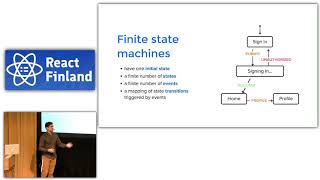 25mMind Reading with Adaptive and Intelligent UIs in React
 31mA Feasibility of On-Device ML for Adaptive User Interfaces in Frontend Development
 25mUsing Machine Learning To Improve UI/UX
 32mDAVID KHOURSHID Making state management intelligent
 22mUsing Machine Learning to Improve UI/UX
 20mBridging the gap between AI and UI
 30mMastering UIs with Finite State Machines
 44mArtificial Intelligence and Machine Learning in the browser