Phase Transitions in Semidefinite Relaxations (A Fast & Robust Algorithm for Community Detection)

summary
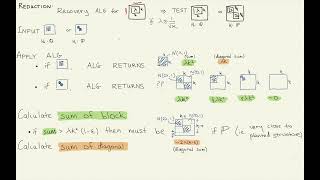
A semidefinite programming approach produces a fast, robust algorithm for community detection by optimizing a relaxed trace objective over low‑rank correlation matrices represented as m‑component vector updates, using coordinate‑wise ascent that aligns each vector to its local field and then projects via the principal direction. It tolerates tiny planted cliques that break spectral methods, runs on n≈10^5 in seconds on a laptop, achieves near‑Bayes performance within 2% of optimal, and needs only modest m (≈6–16, much less than √n).
AI-written summary · about
chapters (24)
- 0:00Intro
- 0:25Outline of the talk
- 1:14Communities detection problem
- 1:59Benchmark for community detection
- 2:37The hidden partition model
- 3:41Assortative SBM with 2 equal-size groups
- 5:18Maximum Likelihood (ML)
- 6:10Lagrangian formulation
- 6:56Spectral relaxation (PCA)
- 8:02Spectral relaxation fails on sparse graphs
- 8:35Why PCA fails?
- 9:09Other spectral methods
- 11:20Improved spectral methods fail on quasi-random graphs
- 14:46SDP: a better relaxation?
- 17:16SDP-based algorithm
- 24:31The algorithm is very robust!
- 25:06The algorithm is very fast!
- 27:00SDP optimality
- 27:36Different estimators
- 28:34Statistical physics approach
- 32:33Analytical solution: dense real case
- 34:43Analytical solution: sparse case (SBM)
- 36:35Approximate analytical solution (SBM)
- 41:05Take-home messages
related talks
 35mLocal Statistics, Semidefinite Programming, and Community Detection II
 32mLocal Statistics, Semidefinite Programming, and Community Detection
 47mLearning Probabilistic Models for Graph Partitioning in the Presence of Noise
 24mIs it easier to count communities than find them?
 56mGraph Matching: Relax or Not?
 09mConvex Programs, Computational Phase Transitions, and Robust Algorithms
 35mSmoothed Analysis of Low Rank Solutions to Semidefinite Programs via Burer Monteiro Factorization
 43mGlobal Community Detection Using Individual-Centered Partial Information Networks