Device-Independent Protocols From Computational Assumptions

summary
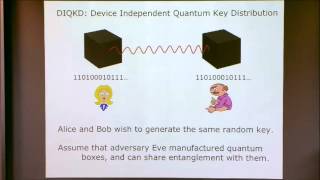
Proposes device-independent QKD that drops the usual no-communication assumption by instead assuming the untrusted device is computationally bounded and cannot break an LWE-based adaptive-hardcore-bit construction; proves a computational self-testing statement that a device winning the protocol must have prepared EPR pairs and performed the requested single-qubit measurements (up to global isometry). Uses remote state preparation with blindness, composes cases to certify Bell outputs, and replaces nonlocal CNOTs by gate teleportation. Theory-level construction, not optimized for efficiency.
AI-written summary · about
chapters (11)
- 0:00Start
- 1:41Outline
- 2:46Device-independent QKD
- 9:04Computational DIQKD setting
- 14:23Computational self-testing
- 16:31Remote state preparation GV'19
- 19:01Main challenges for self-testing EPR states
- 20:14Remote state preparation with two isolated de
- 20:43Parallel implementation with single devic
- 27:54without adaptive hardcore bit Gregs
- 31:28References
related talks
 23mSelf-testing of a single quantum device under computational assumptions
 42mTests for "Quantumness"
 21mQuantum Internet in a Nutshell
 12mOne-Way Functions Imply Secure Computation in a Quantum World
 39mBlind and Verifiable Quantum Computation
 36mFrom Photonic Quantum Cloud Computing to Interactive Proofs
 20mOn the computational hardness needed for quantum cryptography
 38mQuantum Technologies: Quantum Computing & Secure Quantum Communication