Panel Discussion

summary
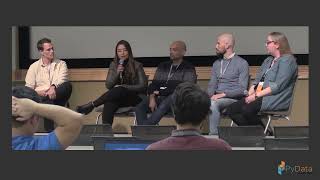
Panelists report concrete workflows and pain points: teams move development and testing into Jupyter notebooks for development, production runs use Python and PyTorch with some teams adding TF support via HuggingFace transformers, and one shop runs training on spot instances + Kubernetes + Horovod on AWS. Funding and sustainability gaps surface — numpy allegedly has ~1–2 full‑time developers while popular OSS libraries need business models — and recurring blockers are a package management gap and poor reproducibility across domains like chemistry.
AI-written summary · about
chapters (17)
- 0:00Intro
- 4:03Central tools and frameworks
- 13:41Tools
- 14:41Funding
- 15:41Open Source
- 18:04Package Management
- 18:29PublicPrivate Partnerships
- 18:50Corporate Partnerships
- 19:47Commercial Software
- 21:46Tools Interoperability
- 24:20Reproducibility
- 25:06Culture
- 26:30Community
- 27:27Tooling
- 28:52Swift
- 30:55Unified Ecosystem
- 33:14PyTorch vs TensorFlow
related talks
 25m#6 Open Source Forum 2019 Adam Gibson
 01h 30mPanel: Building a Stronger Open Source Python Data Community
 16mKeynote: Accelerating AI/ML Development with Open Source Software
 01h 06mSaturday: Lightning Talks
 46mThe Python Data Ecosystem: Navigating a fragmented landscape
 54mKey Challenges In the PyData Ecosystem and How we Can All Make a Difference
 44mKeynote
 42mSimplifying Data Analysis with GitHub Codespaces, Jupyter Notebooks & Open AI