Introduction to Pandas

summary
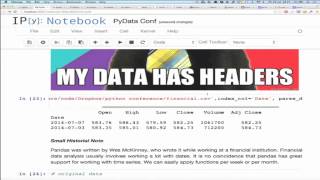
Pandas provides Series and DataFrame primitives for labeled arrays, fast tabular joins and merges, and built‑in handling of missing values; the demo loads CSVs with read_csv, converts strings to datetime, sets the datetime index, resamples five‑minute windows to days, computes cumulative sums and means, and builds pivot_table views and SQL‑style joins (via SQLAlchemy or DataFrame.join). A real problem ingests ~100 vendor formats of spam feedback, pivots and fills NaNs, exports with to_csv, and visualizes results using vincent charts. It works but uses in‑memory frames and can exhaust memory.
AI-written summary · about
chapters (21)
- 0:00Introduction
- 0:16What is Panda
- 2:24Getting Started
- 3:56Series
- 4:36Values
- 5:19Index
- 9:09DataFrame
- 11:57Grouping
- 12:46Grouping Multiples
- 13:35Naming Columns
- 14:11Pivot Tables
- 15:39Join Pivot Tables
- 17:34Real World Problem
- 21:12Indexing Date Time
- 22:44Missing Points
- 25:34Resampling
- 26:26Sorting
- 27:01Describe
- 28:47Vincent
- 30:43Questions
- 41:18Integrate
related talks
 01h 24mIntroduction to Data-Analysis with Pandas
 01h 52mIntroduction to data analytics with pandas
 01h 29mIntroduction to Pandas
 01h 04mVisualising Data through Pandas
 42mUsing Python pandas for scientific Research
 01h 48mPandas for Beginners
 01h 21mIntroduction to pandas
 01h 16mIntro to Data Analysis with Python Data-table