Building valuable Deterministic products in a Probabilistic world
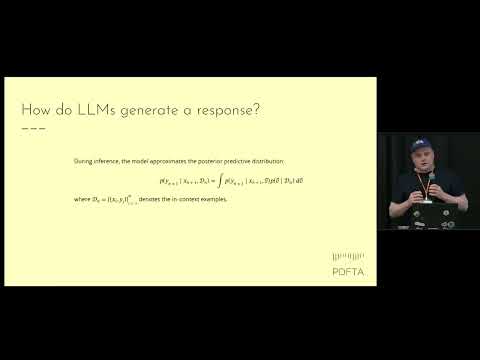
summary
Argument: deliver valuable deterministic products while using AI only where it reduces cost or enables capability that deterministic code cannot. Concrete tools include pydantic validators, DBT integration, CI test runners and simple key–value retrieval; surprising outcome: automated ETL translation reaches 95–97% accuracy and prevents large error classes. Validation strategy emphasizes falsifiability, structured JSON outputs, retries and human review, and metrics like confusion matrices. Engineers build small composable pipelines, measure failures, and iterate rather than promising vague examples.
AI-written summary · about
chapters (8)
- 0:00Deterministic AI products intro
- 2:10Use as little AI as necessary and no less
- 3:56Probabilistic systems & LLMs
- 10:21Structured AI responses
- 14:12Falsifiability & best practices
- 17:02Healthcare MVP case study
- 21:40ETL automation project
- 28:59Conclusion & Q&A
related talks
 38mRedefining Test Data Strategy in the Gen AI Era
 28mWhy Software Quality Is the Key to Scaling AI Development
 20mBuilding Deterministic Infrastructure for Non Deterministic AI Agents
 37mDeterministic modernization in an age of AI
 39mMaking AI Reliable in the SDLC: The Role of Deterministic Context at Scale
 50mFrom Prompt Hacking to Architectural Determinism: Engineering Reliable GenAI Systems
 12mTrust, Design, and the Reality of Security Engineering in an AI-Driven World
 36mEngineering Intent: Solving the AI Productivity Paradox