Fighting Money Laundering with Python and Open Source Software
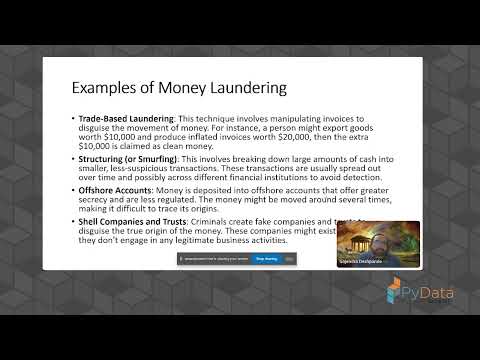
summary
A reproducible Python pipeline ingests heterogeneous bank statements, normalizes columns with pandas, validates integrity with sha256 hashing, flags anomalies with Benford's law (example first‑digit frequency jumping to 35.1% vs expected ~30%), builds directed graphs with NetworkX showing heavier transfers as darker edges, applies ML classifiers on graph features to predict laundering chains, and writes detailed logs for courtroom admissibility.
AI-written summary · about
chapters (9)
- 0:00Introduction
- 1:06Forensic investigation steps
- 5:19Daubert standard compliance
- 8:50Bank fund trail analysis
- 14:08Structuring and smurfing
- 17:22Benford’s law anomalies
- 20:37Transaction graph visualization
- 23:48Logging evidence in Python
- 25:14Q&A
related talks
 17mVerifying the Effectiveness of Money Laundering Through Perpetual DEX
 16mLeveraging ML to Create a Reliable Anti-Fraud System
 46mML for Anti-Money Laundering
 34mSolving Crimes with Python Using Natural Language Processing (NLP)
 18mReal-time Fraud Detection using Deep Learning
 24mHunting Criminals with Hybrid Analytics
 17mThe Hidden Danger in Financial Transactions
 03mJeremiah O'Connor