Using Dask for Parallel Computing in Python

summary
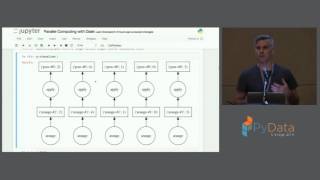
Dask provides parallel arrays, bags, and dataframes that build task graphs from many small NumPy or pandas pieces, run on threads, processes, or a distributed cluster, and execute from Jupyter notebooks. The demo builds a 4 GB HDF5 random array, compares NumPy (~16 s, single thread) to Dask (~3 s, parallel) and shows low RAM use, task visualizations and a progress bar. Exercises use chunking, HDF5, CSV partitions and confirm the approach works.
AI-written summary · about
chapters (8)
- 0:00Dask and parallel computing
- 6:14Dask collections and task graphs
- 17:46Scheduling backends
- 21:37Large arrays on disk
- 27:37NumPy performance comparison
- 32:35Dask bag for JSON
- 34:23Dask data frames and pandas
- 42:39Final notes
related talks
 01h 22mUsing Dask for Parallel Computing in Python
 01h 03mDask: Next Steps in Parallel Python
 01h 26mDask tutorial
 01h 56mParallelizing Scientific Python with Dask
 01h 23mData Science at Scale with Dask
 01h 17mScaling PyData with Dask
 25mDistributed data workflows: PySpark vs Dask
 38mScalable Machine Learning with Dask