Building Continuous Learning Systems
summary
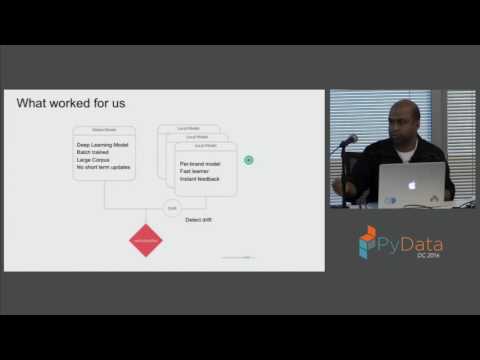
Builds a global convolutional neural net trained on ~8 million tweets (gives 86% cross‑validation) and lightweight per‑brand online models using a passive aggressive online learner to absorb single feedback events; ensembles global+local with a meta classifier and drift detection that captures data between warning and drift triggers and respawns a local model. Vocabulary grows ~10% new words per month, online updates improve running accuracy over a static batch baseline (~74%) while avoiding full retrains.
AI-written summary · about
chapters (22)
- 0:00Introduction
- 3:14Model performance degradation
- 7:55Non-stationary data challenges
- 10:30Need for continuous learning
- 13:00Global and local model architecture
- 16:55Text representation with word2vec
- 21:11Global model as CNN
- 22:37Local model objectives
- 24:20Online learning paradigm
- 28:36Feedback incorporation challenges
- 30:45Passive aggressive algorithm
- 32:09Local model performance
- 33:59Parameter tuning for feedback
- 35:25Validation through feedback
- 36:30Ensembling global and local
- 37:34Detecting concept drift
- 39:00DNN limitations in drift
- 41:10Personalization benefits
- 41:54Passive aggressive drawbacks
- 45:12Ranking models as alternative
- 46:39Key takeaways
- 47:42Q&A
related talks
 41mMachine Learning Models in a Dynamic Environment
 39mChanging Realities - The Final Frontier for Machine Learning?
 38mBuilding robust machine learning systems
 18mBuilding an Incrementally Trained, Local Taste Aware, Global Deep Learned Recommender System Model
 52mSelf-learning Alexa: ML model updates with no human in the loop
 57mMachine Learning in the Age of IoT
 37mCode First, Math Later: Learning Neural Nets Through Implementation and Examples
 37mActive Teaching, Human Learning