Julia for Modern Data Analysis
summary
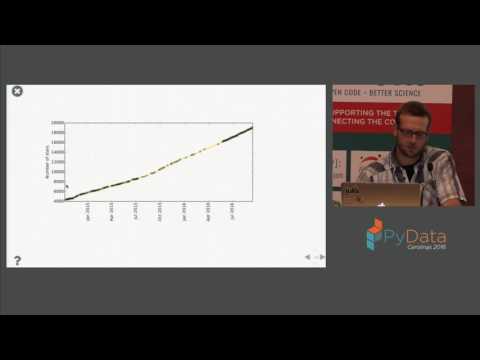
Julia claims high performance through JIT compilation and multiple dispatch and shows concrete tooling: interoperates with Python via PyCall and R via RCall, uses Plots.jl to swap back ends, and supports packages like Distributions, DataFrames and a pure‑Julia MCMC (mamba). Package counts rise from ~600 to ~1,000 and GitHub stars from ~8k to ~17k. A streaming library online_stats is built and runs, and mixed‑model fits run far faster than the same R workflow (which once took a day).
AI-written summary · about
chapters (14)
- 0:00Introduction
- 1:04What is Julia
- 3:54Multiple dispatch
- 6:20Julia vs other languages
- 8:28Julia adoption
- 10:35Julia for stats/data science
- 14:04Optimization & ML tools
- 15:07Upcoming ML tools
- 18:14Julia with R/Python
- 21:28Julia data packages
- 25:01OnlineStats for streaming
- 27:08MCMC with Mamba
- 28:52Julia future & limits
- 29:58Q&A
related talks
 43mJulia for Data Analysis features, interfaces and future directions
 01h 07mJulia Tutorial
 01h 27mIntroduction to Julia for Scientific Computing and Data Science
 01h 38mAn Introduction to Julia
 01h 06mJulia: Fast Performance, Distributed Computing & Multiple Dispatch
 01h 37mTech Tutorial: Use Julia for your next scientific computing job!
 02h 00mIntroduction to Julia
 28mDiscover the Julia Machine Learning Ecosystem