Using Machine Learning to solve a classification problem with scikit-learn
summary
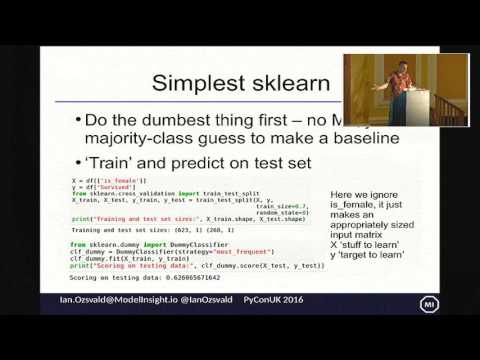
Uses the Titanic dataset to show a reproducible Python workflow with scikit-learn, starting from a dummy classifier baseline (about 62% accuracy) and moving to a Random Forest that reaches roughly 78% accuracy. Covers concrete feature engineering steps (titles, family size, fare), a practical fix for missing ages by imputing a sentinel value (-100), interprets a confusion matrix (e.g. ~140 true-died vs 28 false-survived) and inspects feature importances (fare highest), plus cross-validation and debugging strategies with runnable notebooks and code.
AI-written summary · about
chapters (13)
- 0:00Intro
- 1:14Introductions
- 3:54We'll briefly cover..
- 5:27Process
- 6:12Data overview
- 7:47Seaborn plots for EC
- 9:26Training and Testing
- 11:24Simplest sklearn
- 12:19Random Forests
- 13:00Random ForestClassi
- 15:35Dealing with NaN/N
- 17:09Debugging
- 21:11Closing...
related talks
 44mA Practical-ish Introduction to Data Science
 01h 23mMachine learning in Action
 39mPredicting Titanic Survivors with Machine Learning
 57mHow To Evaluate and Improve Machine Learning Models
 51mHow to Test Artificial Intelligence and Machine Learning Solutions?
 37mCreating correct and capable classifiers
 42mCreating correct and capable classifiers
 54m"Would YOU Survive the Titanic?", with ML and .NET