Programming microbes using Python

summary
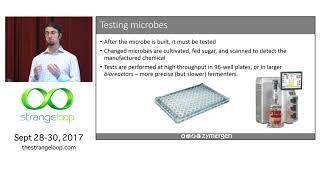
Zymergen edits microbial genomes, builds variants with robots and tests them in 96‑well plates, then scales winners to large tanks; the data pipeline uses Python tooling like BioPython, CobraPy, Escher, goatools, NetworkX, TensorFlow, PyStan, Airflow and an in‑house compiler Helix. Feature extraction uses flux balance analysis to produce flux matrices feeding ML models that recommend edits (for example removing a gene), coping with costly experiments, epistasis, and a combinatorial space (4,000 genes → ~10^17 six‑way combos).
AI-written summary · about
chapters (12)
- 0:00Intro
- 0:23Microbes can produce chemicals
- 2:00Zymergen's high-throughput testing
- 3:38Robotic automation drives throughout
- 7:49Genome optimization is hard
- 10:57Experiments are expensive & time consuming
- 11:43Challenges Recap
- 17:28Extracting metabolic features from Cobrapy
- 17:46Extracting metabolic features using Cobrapy
- 19:55CabraPy: a subset of reactions are modeled
- 20:27CobraPy: linear steady-state modeling
- 21:21Maps were made with using ESCHER
related talks
 38mPython in Bioinformatics
 39mDesigning 1000 genomes in a single bound: The Codon DSL
 48mReprogramming Biology
 47mPython for Bioinformatics
 42mPython’s role in accelerating biomedical science
 23mGenomics and AI on Cloud Foundry
 25mUsing Python Biopharm to Help Cure Cancer
 21mMachine Learning and Microbiology in the Cloud Through Ray