Theory, Design, and Implementation of Projection-based Assertions for Quantum Debugging
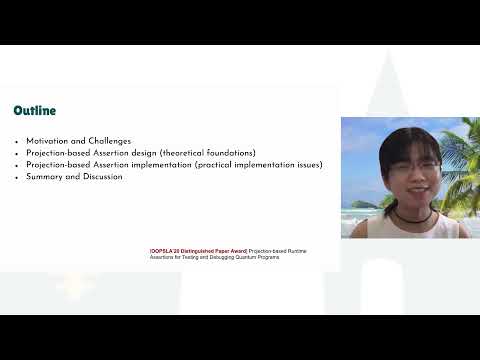
summary
Presents a concrete runtime testing method that inserts projection-based assertions as projective measurements, implements them on real gate-model devices by using unitary-basis change (apply+measure+undo) and by decomposing non-integer-rank projections into sequences or adding an ancilla qubit when rank > half the space. Gives a rank-3 on 4-qubit example, derives the number of executions from trace probabilities (few runs suffice), and shows the technique reduces errors in molecule-simulation programs when applied in practice.
AI-written summary · about
chapters (21)
- 0:00Introduction
- 1:20Why Quantum Computing
- 2:08Quantum Research at UCSD
- 4:34Verification vs Testing
- 5:30Quantum Program State
- 7:53Quantum Program Testing
- 10:13Key Challenges
- 11:10Limitations
- 12:20New Approach
- 16:04Projection Properties
- 16:56Why Projection
- 17:20Projectionbased assertion
- 19:40Approximate projectionbased assertion
- 21:32Practical implementation issues
- 22:11Limited measurement basis
- 22:52Dimension mismatch
- 26:03Circuit
- 26:28HighLevel Idea
- 27:15Corner Cases
- 27:45Solution
- 29:13Takehome message
related talks
 16mProjection-Based Runtime Assertions for Testing and Debugging Quantum Programs
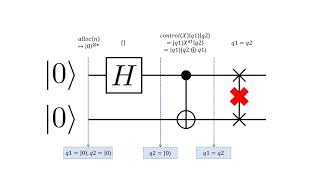 15mAssertion-Based Optimization of Quantum Programs
 41mQuantum Abstract Interpretation
 42mQuantum program analysis: Verification and Testing
 23mA Unified Assertion-Based Framework for Classical-Quantum Program Verification
 22mQbC: Quantum Correctness by Construction
 01h 01mInvited Talk: Welcome to Quantum 3.0!
 22mEfficient Formal Verification of Quantum Error Correcting Programs