Compiling Python Programs into Differentially Private Ones
summary
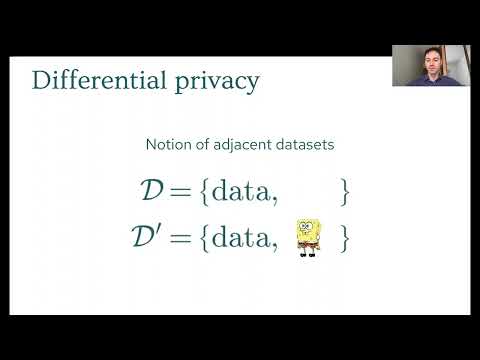
A service ingests CSV or SQL data, computes differentially private marginals, and trains a DP generative model to produce synthetic data for offline iteration. Python code written with stubs of pandas/numpy records a computational graph that the compiler analyzes, then inserts DP mechanisms or computes DP statistics so inputs become entity-preserving. Training uses DP-SGD when possible; if the graph cannot be made preserving the system falls back to the synthetic-data path. The pipeline runs end-to-end and returns a DP-guaranteed model or result.
AI-written summary · about
chapters (6)
- 0:00Intro
- 0:51Data onboarding
- 2:03Data job description
- 4:12Differential privacy
- 4:49Identify the protected entity
- 7:12How to compile ?
related talks
 13mDPSynth: From Research to Production—Engineering Differentially Private Synthetic...
 36mGenerating realistic, differentially private data sets using GANs
 44mDifferentially Private Inference for Regression Coefficients
 45mPractical Experience with Making Synthetic Data Differentially Private
 48mSynthetic Data as an Enabler for Learning from Decentralized Private Data
 01h 14mStatistical Inference and Privacy, Part III
 19mPractical Considerations for Differential Privacy
 14mEstablishing Privacy Metrics for Genomic Data Analysis