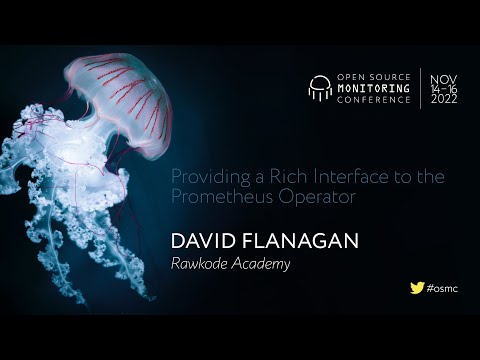
Providing a Rich Interface to the Prometheus Operator
summary
Shows how Pulumi and the Kubernetes CDK replace bulky YAML by generating language SDKs from CRDs (via crd2pulumi or CDK imports) and authoring resources in Go, Python, TypeScript or .NET. Demonstrates server-side apply, component resources that bundle deployment, ServiceMonitor, Prometheus and Alertmanager, and publishing reusable packages. Example builds a full Prometheus stack (about 240 lines of TypeScript instead of fragmented YAML), deploys successfully to a cluster with Prometheus, Alertmanager and app pods visible, and enables IDE autocompletion and unit testing.
AI-written summary · about
chapters (13)
- 0:00Introduction and speaker intro
- 1:46YAML pain in Kubernetes
- 5:15Problems with Helm and templating
- 7:44Why use programming languages
- 9:08Pulumi vs CDK for Kubernetes
- 13:00Tool comparison and trade-offs
- 13:42Demo: Generating CRD SDKs
- 15:06Demo: Pulumi TypeScript setup
- 18:18Demo: Deploying Prometheus stack
- 22:37Demo: Adding monitors and rules
- 24:30Demo: Debugging and verification
- 25:32Demo: CDK TypeScript setup
- 26:36Summary and key takeaways
related talks
 33mGo from Kubernetes YAML to software engineer with CDK8s
 26mFive Hundred Twenty-five Thousand Six Hundred K8s CLI’s
 35mStop being a YAML engineer, be a software engr. with CDK8s
 34mInfrastructure as Software
 01h 17mTutorial: Say Goodbye to YAML Engineering with the CDK for K8s
 16mSay goodbye to YAML engineering with the CDK for Kubernetes
 32mRevolutionise your Kubernetes game with cdk8s
 18mSimplify Managing Your Applications on Kubernetes with CDK8S