LVMT: An Efficient Authenticated Storage for Blockchain

summary
Claims a storage layer called LVMT that swaps Merkle Patricia Tries for an AMT vector commitment plus a multi-layer trie, stores version numbers instead of value hashes to avoid expensive elliptic curve multiplications, and shards proof maintenance by key prefix. Implementation shows read/write operations run about six times faster than MPT, read amplification falls to near-constant for existing keys (two-layer LVMT holds ~20 billion versions), and end-to-end block execution throughput increases up to 2.7x execution throughput.
AI-written summary · about
chapters (9)
- 0:00LVMT and blockchain storage
- 1:11Transaction execution bottleneck
- 2:57Authenticated data structures limits
- 5:23AMT advantages over Merkle trees
- 7:09Version-based AMT design
- 8:57Multi-level AMT structure
- 10:43Proof sharding benefits
- 11:24LVMT performance evaluation
- 13:53Performance improvements and conclusion
related talks
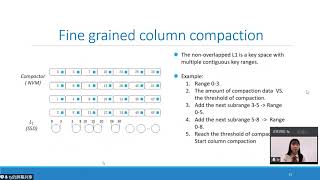 21mMatrixKV: Reducing Write Stalls and Write Amplification in LSM-tree Based KV Stores
 21mCOLE: A Column-based Learned Storage for Blockchain Systems
 34mPrivacy All the Way Down: Tackling MEV at Different Layers via. Cryptography
 18mMEV Minimization on L2: Solution Space and Design Constraints
 01h 09mLMDB
 13mDifferentiated Key-Value Storage Management for Balanced I/O Performance
 18mMEVconomics for Modular Blockchain Stacks
 01h 12mScaling distributed ledgers: Achieving arbitrary throughput and sub-second latency