Future-Proof Your Applications: Avoid Breakdowns With Cgroup Chan...

summary
Shows how to migrate real workloads from cgroup v1 (introduced in 2.6.24) to unified cgroup v2 (stable since 4.5) with concrete commands: uses cgcreate, libcgroup abstractions (hyphen-1/2 mappings), systemd slices and cgconfig to make setups persistent, and cgpt/cgtop-style demos that allocate CPU.max and memory.max (weights range 1–10000, default 100). Demonstrates giving a cgroup 80% CPU to five tasks, using PSI to read 10/60/300s stall percentages, and freezing a cgroup to stop CPU while retaining allocations.
AI-written summary · about
chapters (12)
- 0:00Cgroups introduction
- 1:28Live demo: cgroup basics
- 5:58History of cgroups
- 7:44Cgroup hierarchies
- 9:09Cgroup v1 vs v2 differences
- 11:40Persistent cgroups setup
- 12:03Migrating to cgroup v2
- 17:05Cgroup v2 rules
- 18:52Lipgroup migration abstractions
- 21:37QoS in cgroup v2
- 26:55Pressure Stall demo
- 32:41Q&A
related talks
 38mUnderstanding and Working with the Cgroups Interface
 57mAn introduction to control groups (cgroups) version 2
 34mCgroups and Enterprise Users
 01h 02mDiving deeper into control groups (cgroups) v2
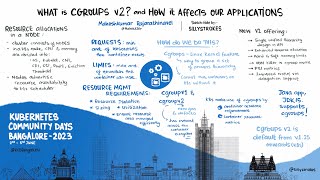 32mWhat is cgroups v2? and how it affects our application
 27mPostgreSQL container groups, aka cgroups down the road
 45mLinux Kernel Control Group v2
 48mBrave new world of unified cgroup hierarchy