Next-Gen Documentation with AI

summary
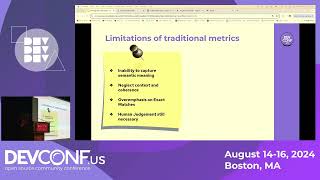
Claims that LLMs can auto-generate API and code docs get tested: a Streamlit UI pulls Python files from GitHub, runs open‑source models (Mistral, Llama, IBM Granite) via oLama or hosted APIs, and evaluates outputs with BLEU/ROUGE, an LLM scorer and human reviewers. The system produces usable templates but also frequent hallucinations and low automatic scores versus hand‑written docs, so it works for rapid prototyping on laptops and for on‑prem privacy deployments yet still needs human‑in‑the‑loop validation and tuning.
AI-written summary · about
chapters (16)
- 0:00Introduction
- 1:03Documentation evolution
- 6:50Generative AI overview
- 8:57How LLMs work
- 13:32Context window in LLMs
- 17:07LLM use cases
- 20:20LLMs for documentation
- 22:04Implementing an LLM application
- 25:15Third-party LLMs
- 28:04Local LLM deployment
- 30:33On-prem LLM solutions
- 34:33Demo: auto docs
- 42:02Evaluating LLM docs
- 44:31Challenges and limitations of LLMs
- 45:35LLMs future in docs
- 47:24Call to action
related talks
 49mNext-Gen Documentation with AI
 37mDocumenting your open source projects for machines
 34mBuilding Trust with LLMs
 35mHarnessing AI for API Business Documentation in a Devportal CMS [...]
 18mLLMs and GenAI: A Guide to Building Your Own RAG Model for Document Interaction
 29mGenerative-AI: Usecase-Specific Evaluation of LLM-powered Applications
 28mA community based open source LLM and what it can do for your business
 43mLarge Language Models for Devs: from zero to your first LLM application