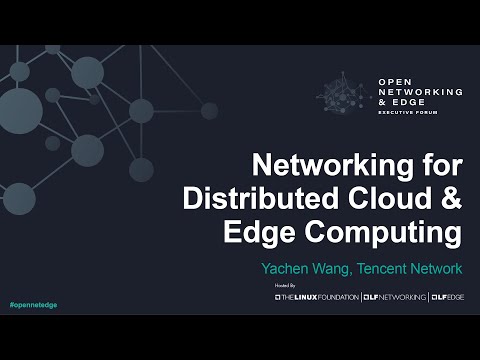
Networking for Distributed Cloud & Edge Computing
summary
Tencent runs a distributed cloud with 27 regions, >2M servers, >3,000 PoPs and ~300 edge nodes, and moves from a software gateway (VPP/DPDK, ODL then microservices SDN, BGP/BFD) that consumes ~30% of small-site servers to a hardware offload: P4 offload on smart switches with FPGA/NPUs, SONiC on Tencent Linux, Dockerized applications and gRPC telemetry. The phase change yields much higher throughput, lower latency and cost: cloud gaming shows ~50% RTT reduction and ~30–40% bandwidth OPEX savings.
AI-written summary · about
chapters (11)
- 0:00Intro
- 0:34Tencent: An Internet-based Technology and Cultural Enterprise Neo-culture Creativity
- 1:49Tencent Cloud Infrastructure
- 2:44Tencent Network Overview
- 4:39Tencent Distributed Cloud
- 6:09Distributed Cloud Network: Key Technologies
- 7:22Edge Interconnection Network
- 8:21Programmable HPN: Motivation
- 10:29Programmable HPN: Architecture
- 11:53Programmable HPN : Software Platform
- 13:22Use Case - Cloud Gaming
related talks
 01h 25mDay 2 Part 1 Sessions
 12mAccessing Cloud with Disaggregated Software-Defined Router
 25mKeynote: Network Transformation: Are We Ready for 5G and Edge Clouds?
 19mKeynote: Network of Tomorrow - 5G and Edge
 26mApplying New High-Throughput Network Solutions in IEC (Integrated Edge Cloud)
 12mP4EC: Enabling Terabit Edge Computing in Enterprise 4G LTE
 14mLuoShen: A Hyper-Converged Programmable Gateway for Multi-Tenant Multi-Service Edge...
 19mCluster Optimization: Harnessing DPUs for Ambient Mesh Workloads