Scopes as Types
summary
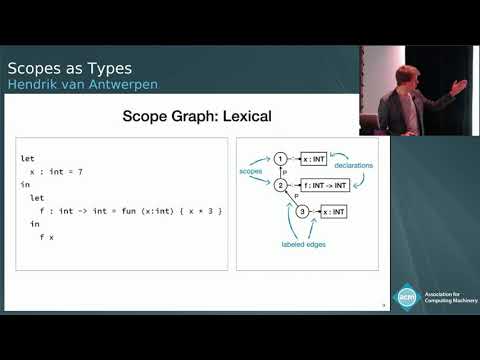
Scope graphs model name binding and the paper’s main claim is that treating scopes as types lets one encode structural and generic type internals uniformly. A new meta-language Statix and a committed-choice solver implement declarative rules that interleave graph construction and delayed name-resolution; specs execute for STLC with records, System F and Featherweight Generic Java. The implementation succeeds on many test suites but fails on user-written cyclic specifications where queries and edge construction depend on each other.
AI-written summary · about
chapters (18)
- 0:00Intro
- 2:13Declarative Specification and Name Resolution
- 2:47Binding: Lexical
- 4:13Binding: Structural Records
- 5:37Binding: Modules
- 6:36Common Binding Representations in Specifications
- 7:22Our Approach
- 8:02Scope Graph: Lexical
- 10:23Scope Graph: Records
- 11:39Scope Graph: Modules
- 13:28Statix: Declarative Rules
- 16:22Interleave Graph Construction and Queries
- 18:07Execution by Rewriting
- 19:19Unorderable Constraints get Stuck
- 20:30Implementation
- 20:56Case Studies: Setup
- 21:33Case Studies: Languages
- 22:14Declarative, Executable Type System Specifications