Let's Take Esoteric Programming Languages Seriously

summary
Claims that esoteric languages boost programmer awareness and teach language design through constraint and surprise, backed by concrete examples: Whitespace uses three invisible lexems (tab space newline), Piet treats images as stack opcodes with a direction pointer, Fractran produces primes by repeated integer×fraction steps, and INTERCAL ships a working C compiler called Ick (apt install works on Intel Macs but not newer ones). Roughly half of audiences report having written esoteric programs, many have implemented interpreters, and recent books catalogue 44–50 esolangs for pedagogy and creative practice.
AI-written summary · about
chapters (16)
- 0:00Esoteric languages intro
- 1:10Whitespace & Pete explained
- 3:18Shakespeare language
- 6:08Why take them seriously
- 8:59Definitions
- 11:07INTERCAL archetype
- 15:26Categorizing esoteric programming languages
- 18:41Non-textual models
- 21:59Why computer scientists love them
- 24:06Nostalgia & challenge
- 27:40Community & initiation
- 30:30Pedagogic & artistic value
- 32:21Reasons to create
- 34:08Related work
- 35:54Conclusion
- 36:15Q&A on constructed languages
related talks
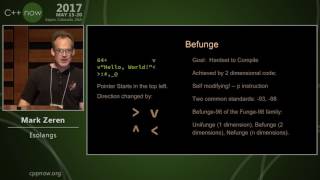 05mEsolangs
 36mBusy Developer's Guide to Esoteric Languages
 26mEsoteric Languages, from O to brainfuck
 35mEsoteric, Obfuscated, Artistic Programming in Ruby
 39mEsoteric, Obfuscated, Artistic Programming in Ruby
 52mThe Programming Language as a Musical Instrument
 40mThe charm of the supercazzola (...)
 01h 01mThe Art of Code