Foundational Design Principles and Patterns for Building Robust & Adaptive(…)

summary
Argues future systems embed GenAI but design for probabilistic outputs by adding runtime checks, metadata and feedback loops, plus mechanisms to convert slow agentic work into fast deterministic logic; defines five pillars—reliability, excellence, evolvability, self‑reliance, assurance—and concrete patterns like GenAI-native cells and programmable routers that route fast-path requests to traditional code and fall back to agentic processing, expects validation experiments and a GenAI-native software stack to measure cost, latency and error‑tolerance. self-assess
AI-written summary · about
chapters (9)
- 0:00GenAI impact on software design
- 3:09Integrating GenAI into systems
- 7:46Resilience in GenAI systems
- 11:10Tolerance in GenAI components
- 17:32Past tech transformations
- 20:59Organizational analogies for GenAI
- 23:28Microservices with GenAI
- 27:00Future GenAI design call
- 27:42Q&A: Explainable AI
related talks
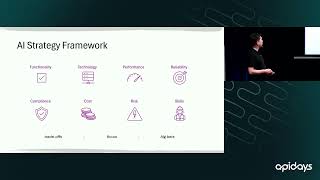 29mWhen to Gen AI? A strategic framework for real-world AI adoption
 01h 01mSoftware Architecture for Gen AI
 33mThe Future of Developer Experience with GenAI: Driving Engineering Excellence
 14mThe 4 Patterns of AI Native Development
 46mIntelligence as Infrastructure: What Developers Must Learn to Build with AI
 27mEmerging Patterns Agentic AI
 36mEngineering Intent: Solving the AI Productivity Paradox
 33mBuilding an Agentic Design System